
 Brazil
In this story 6 sections
Two goals against Chile, then a red card
Garrincha scored twice against Chile in the 1962 World Cup semi-final, helping Brazil win 4–2. Late in the match, he was sent off. He was still allowed to play in the final, where Brazil beat Czechoslovakia and retained the trophy. The sequence is an unusual frame for a player remembered for making football feel light: two goals, a dismissal and a second world title in the same week.
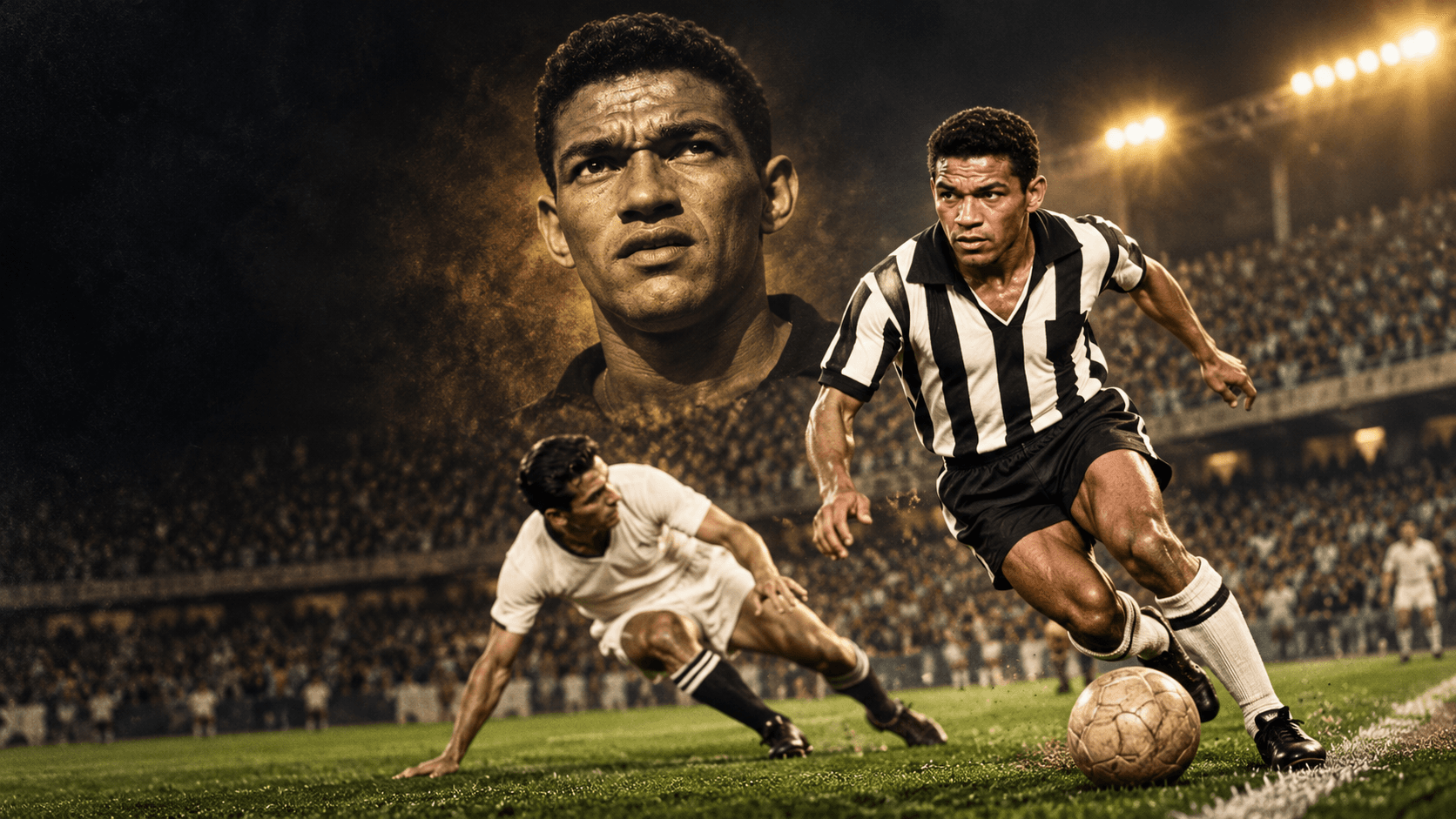
Born Manuel Francisco dos Santos in Pau Grande on 28 October 1933, he became known as Mané Garrincha, after a small bird. He was a right winger whose balance, timing and change of pace made a familiar feint hard to defend. Full-backs often knew which way he wanted to go; that knowledge did not make them any safer.
The right wing at Botafogo
Botafogo signed Garrincha in 1953. He stayed until 1965 and made 612 appearances, scoring 245 goals, according to the club. The honours include three Campeonato Carioca titles and two Rio–São Paulo tournaments. For supporters, those years established him as more than a successful winger: he became one of the club’s defining figures.
The story of his first training session is still told at Botafogo. The club says Garrincha put the ball through Nílton Santos’s legs, and the experienced left-back asked for him to be signed. The anecdote has the shape of a legend, but the point is clear: Garrincha could make a defender look helpless from the first touch.
The first World Cup in Sweden
Garrincha was in Brazil’s squad for the 1958 World Cup, when the country won the trophy for the first time. Pelé, Didi, Vavá, Zito and Nílton Santos were among his teammates. Against the Soviet Union, coach Vicente Feola started Garrincha and the 17-year-old Pelé together. Brazil won 2–0.
Garrincha did not have to carry the team alone. His presence on the right forced opponents to choose: leave him one-on-one and risk being beaten, or send help and open space elsewhere. Pelé and Garrincha were different kinds of threat, but both could change a match before the defence had settled.
Brazil returned as holders in 1962, but Pelé was injured early in the tournament. Garrincha took on more of the attacking responsibility. He scored twice against England in the quarter-final, then twice again against Chile in the semi-final. FIFA’s account notes that he scored with both feet and helped create the space for Vavá’s third goal.
The 4–2 semi-final also ended with Garrincha sent off. He was allowed to play the final, where Brazil beat Czechoslovakia 3–1. The team had other match-winners, including Amarildo, Vavá and Didi, but Garrincha’s contribution while Pelé was unavailable made him the tournament’s outstanding attacking figure.
After the peak
Brazil went out in the group stage of the 1966 World Cup after defeats by Hungary and Portugal. It was Garrincha’s last major tournament with the national team. He later played for Corinthians, Flamengo, Portuguesa, Olaria and Atlético Junior in Colombia, but none of those spells matched his years at Botafogo.
Alcohol dependence marked his life away from football. It is part of his biography, and it should not be used as a neat explanation for every later difficulty. Garrincha died in Rio de Janeiro on 20 January 1983, aged 49. Botafogo records cirrhosis as the cause of death.
The defender knew what was coming
Garrincha’s honours tell part of the story: a central figure at Botafogo and a World Cup winner in 1958 and 1962. The 1962 campaign, when Pelé was unavailable, remains one of the great individual tournament performances.
The lasting image is still a one-on-one on the right touchline. A defender knew Garrincha wanted to move past him. The crowd knew too. Knowing the plan and stopping it were different problems.